Saturday, 9 June 2012

Book Review - God in Our Midst by Daniel Hyde

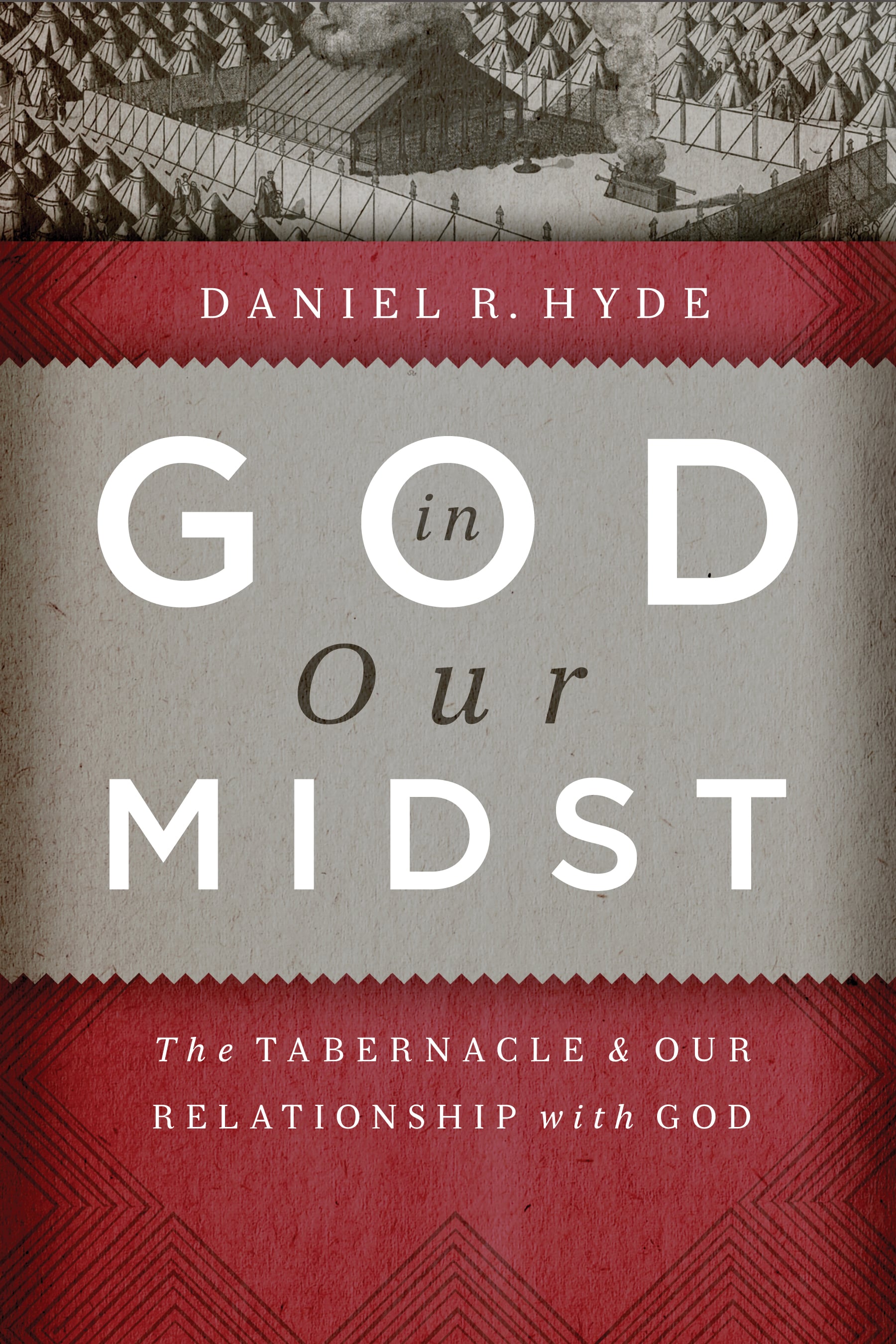
God in Our Midst: The Tabernacle and Our Relationship with God

I admit to being a sceptic when it comes to books and sermon series about the tabernacle, priests garments, and so forth. It seems to me that some writers and preachers see too much in the tabernacle. Surely one or two sermons, or a dozen or so pages, ought to cover it? Surely the Gospels and Hebrews give all the inspired and authoritative explanation of the tabernacle that Christians need? In fact, in Hebrews when speaking of the tabernacle, the unnamed author says 'Of these things we cannot now speak in detail' (Hebrews 9:5).

This book by Pastor Daniel Hyde is 220 pages of text and I was thinking, before reading it, that he probably sees too much. I really liked Alec Motyer's 15 pages in The Message of Exodus. However, the tabernacle instructions form a large part of Exodus and are therefore important to understand. In reading a larger book about the tabernacle I would expect the following:

  • Why is the tabernacle needed at this point?
  • What has God been doing in history up until this point?
  • What was the purpose of the tabernacle?
  • What did it mean to the people at the time?
  • What does it mean to Christians today?
Thankfully, the author also thinks some of these questions are important (p. 2) and seeks to answer them in the Introduction.

Daniel Hyde says 'The common purpose of Eden, the tabernacle, and the temple was that the creature could have fellowship with the Creator' (p. 25). He goes on to say:

They had experienced the reality that they were the "treasured possession" of the Lord (Ex. 19:5), but they had no Bibles. They had become a "kingdom of priests" (Ex. 19:6), but they had no catechisms. They had become a "holy nation" (ex. 19:6), but they had no Sunday school. How would the Lord teach a congregation that no doubt numbered two to three million souls (cf. Num. 1:45, 47) to leave behind the idolatry they had seen and experienced in Egypt, and to cling in faith to Him alone, having no other gods before Him (Ex. 20:3)? How would He instruct them to leave the false worship they had seen in Egypt and participate in the pure worship of God alone, having no carved images (Ex. 20:4)? The answer to these questions was the tabernacle. (pp. 45-46)
The author then makes his way through the Exodus narrative. The contents of 'God in Our Midst' were originally sermons and therefore the book reads very well. One stand-out feature is the amount of scripture Hyde quotes, particularly scripture that links OT with NT. Another stand-out feature is the very searching application (e.g. see pp. 54-55 and pp. 69-70). A final stand-out feature are the quotes from Church Fathers, creeds, and confessions. These writings and documents, although not perfect, were often forged in defence against heresy and are often profound.

There are only a few places when I thought the explanation of some feature of the tabernacle furniture was overwrought. For example. in chapter 4 - The Table With Bread - Hyde explains the crown molding around the table was to keep the bread and all holy utensils from falling off the table. He then goes on to say that '[t]his is a wonderful picture of the care of God for His people' (p. 76). Maybe, maybe not. I wonder if this is a case of 'the right doctrine from the wrong text'? Also, in chapter 6 - The Construction of the Tabernacle - Hyde makes the link from detailed instructions given to Moses to instructions for the for the worship of the Church (i.e. the regulative principle of worship - we only do what God has positively commanded). But why is Jesus not the point of this? We only come to worship Jesus in the way he has described - through Jesus. I will need to mull these points over but on first read they seemed a little off when compared to the rest of Hyde's applications.

This is a good devotional book on a large part of scripture that could be a little remote to most Christians today. Daniel Hyde has done a good job in showing the relevance of the tabernacle. There was at least one line of thought that was hinted at in the book, particularly in the conclusion (pp. 209 - 211), which is rattling around in my head - the tabernacle was a picture of Heaven. I would love to read more about this.

So has Daniel Hyde cured my scepticism? A little, but I still like Alec Motyer's 15 pages.

* To comply with Federal Trade Commission guidelines, I will receive a free copy of the book as compensation for this review. It was supplied by Reformation Trust.

Sunday, 27 May 2012

Book Review - The Good God: Enjoying Father, Son and Holy Spirit by Mike Reeves

I must admit to being a little indifferent to reading about the Trinity. Many standard systematic theologies make it sound like the dullest and most difficult Christian teaching. The readers of such tomes is often left wondering what the practical benefit of the Trinity is. Also, I may be like many people and like my doctrine to be easily grasped by the mind and simply dismiss something that is too difficult (at least for me.)

The Good God is not like some of the previous books and sections in books that I have read on the subject of the Trinity. Reeves frequently has a great turn of phrase that makes the book an entertaining read - "Far, far from theological clutter, God's being Father, Son and Spirit is just what makes the Christian life beautiful." (p. 82)

The point of the book, according to the author, is to help the reader see the real difference the Trinity makes:

"For all that we may give an orthodox nod of the head to belief in the Trinity, it simply seems too arcane to make any practical difference to our lives." (p. ix)
And what is the practical difference? Reeves summarizes:
"...but if God were just one person, then love of the other would not be central to his being. There would have been nobody in eternity for him to love. Thus the only God inherently inclined to show mercy is the Father who has eternally loved his Son by the Spirit. Only with this God do such winning qualities as love and mercy rank highly." (p. 91)
The book is structured very simply in to four chapters dealing with the Trinity as presented in the Bible and church history and a fifth chapter acting as a capstone focusing on the glory of the Trinity. These chapters are:
  1. What was God Doing before Creation?
    • "Before creation, before all things, we saw, the Father was loving and begetting his Son. For eternity, that was what the Father was doing. He did not become Father at some point; rather, his very identity is to be the one who begets the Son. That is who he is. Thus it is not as if the Father and the Son bumped into each other at some point and found to their surprise how remarkably well they got on." (p. 15)
  2. Creation: the Father's Love Overflows
    • "Single-person gods, having spent eternity alone, are inevitably self-centred beings, and so it becomes hard to see why they would ever cause anything else to exist ... [c]reating just looks like a deeply unnatural thing for such a god to do. And if such gods do create, they usually seem to do so out of an essential neediness or desire to use what they created merely for their own self-gratification. Everything changes when it comes to the Father, Son and Spirit. Here is a God who is not essentially lonely, but who has been loving for all eternity as the Father has loved the Son in the Spirit. Loving others is not a strange or novel thing for this God at all; it is at the root of who he is." (p. 23)
  3. Salvation: the Son Shares what is His
    • "It means that this God makes no third party suffer to achieve atonement. The one who dies is the lamb of God, the Son. And it means that nobody but God contributes to the work of salvation: the Father, Son and Spirit accomplish it all. Now if God were not triune, if there was no Son, no lamb of God to die in our place, then we would have to atone for our sin ourselves. We would have to provide, for God could not. But - hallelujah! - God has a Son, and in his infinite kindness he dies, paying the wages of sin, for us. It is because God is triune that the cross is such good news." (p. 55)
  4. The Christian Life: the Spirit Beautifies
    • "But the Spirit's first work is to set our desires in order, to open our eyes and give us the Father's own relish for the Son, and the Son's own enjoyment of the Father." (p. 80)
  5. 'Who among the god is like you, O LORD?'
    • "Love for the Lord, love for neighbour - that is the heart of holiness and how the triune God's people get to be like him." (p. 95)

This book has given me a hunger to study more about the Trinity, in the Bible and in church history, but even more importantly, it has given me a great hunger for the triune God I claim to worship. I recommend it to all Christians as well worth a slow, contemplative read. It would be great for book clubs to read and discuss. Maybe it could result in healthier Christians who just want to overflow with love.

Friday, 25 May 2012

Men, porn and computer games.

Dr Russell Moore has written an excellent article on why many young men are addicted to pornography and video games.It is called Fake Love, Fake War: Why So Many Men Are Addicted to Internet Porn and Video Games.

Dr Moore says:

There's a key difference between porn and gaming. Pornography can't be consumed in moderation because it is, by definition, immoral. A video game can be a harmless diversion along the lines of a low-stakes athletic competition. But the compulsive form of gaming shares a key element with porn: both are meant to simulate something, something for which men long. Pornography promises orgasm without intimacy. Video warfare promises adrenaline without danger. The arousal that makes these so attractive is ultimately spiritual to the core.
...these addictions foster the seemingly opposite vices of passivity and hyper-aggression. The porn addict becomes a lecherous loser, with one-flesh union supplanted by masturbatory isolation. The video game addict becomes a pugilistic coward, with other-protecting courage supplanted by aggression with no chance of losing one's life. In both cases, one seeks the sensation of being a real lover or a real fighter, but venting one's reproductive or adrenal glands over pixilated images, not flesh and blood for which one is responsible.

I think this is perceptive and worth integrating in to our thinking, particularly if we minister in some way to young men.

Wednesday, 23 May 2012

CIS Lecture - The Theology of the Fall

This should be a stimulating lecture especially given the recent discussions around the historical reality of Adam, the purpose of Genesis 1-2, Paul's use of Adam in the New Testament, and so forth.

The Theology of the Fall.

Thursday, 17 May 2012

Book Review - Relationships: A Mess Worth Making by Tim Lane and Paul Tripp

Reading any book, I have found, authored or co-authored by Paul Tripp is an enlightening experience. 'How People Change', 'Instruments in the Redeemers Hands', 'War of Words', 'Age of Opportunity', and so forth. Tripp frequently describes scenarios from his counseling experience that could be about me. Spooky. Relationships: A Mess Worth Making is no different. As with every book coming from the CCEF group, the authors will take a very practical approach that highlights the sinful heart at the root of our relationships. But they never leave it there. They always show the resources available to us in Jesus. They say, "And even while we are basking in God's forgiveness, we find it incredibly difficult to bear with the sin and weakness of others. That's why, in the mirror of mercy, all of us look the same." (p. 135)

The authors start by locating our relationships in the nature of God and explain that we were made for relationships. They move on to discuss how sin impacts our relationships:

  • Self-centeredness
  • Self-rule
  • Self-sufficiency
  • Self-righteousness
  • Self-satisfaction
  • Self-taught
So we are made for relationships but our relationships are frequently screwed up to one degree or another. To help us see through this fog and make real progress the authors move on to discuss a number of topics important to relationships. For example, when discussing hope, they state:
The problem with relationships is that they all take place right smack dab in the middle of something, and that something is the story of redemption, God's plan to turn everything in our lives into instruments of Christlike change and growth. You and I never get to be married to a fully sanctified spouse. We will never be in a relationship with a completely mature friend. We will never live next to a neighbor utterly free of the need to grow and change. We will never have self-parenting children. We will never be near people who always think, desire, say, or do the right things. And the reason for all this is that our relationships are lived between the already and the not yet (p. 108).

I particularly found the chapters on Hope and Mercy to be massively important. The authors have a way with crafting a sentence that strikes me deep down. For example, they describe Psalm 57 as pain-stained worship (p. 169). With regard to mercy they say:

Mercy is my commitment to live along side you in this broken world even though I will suffer with you, for you, and because of you. I will do everything I can to relieve your distress. (p. 137)

I could continue to provide quotes but that may breach some copyright. I would highly recommend this book to all Christians. It is causing me to seriously address some issues in my life.

New Commentary on Revelation by Douglas F Kelly

I want to alert people to a new commentary on Revelation by Professor Douglas F Kelly. Prof Kelly is pastor at Reedy Creek Presbyterian Church, Minturn, South Carolina and the Richard Jordan Professor of Theology, Reformed Theological Seminary, Charlotte, North Carolina.

You can find the Introduction here.

You can find the endorsements, ToC, series preface and author preface here.

It is published by Christian Focus Publications and is available now in the UK (July for the USA). Some of you will know Willie MacKenzie and his passion for publishing books that are helpful for Christians. He is to be congratulated (along with his team) for the output of CFP up until now and, no doubt, for what is coming in the future.

Monday, 14 May 2012

Colin Adams is blogging again

Colin Adams, Pastor at Ballymoney Baptist Church in Northern Ireland, is blogging again at Unashamed Workman. He is now a local guy (via Glasgow and Edinburgh) and always writes thoughtful stuff.