Showing posts with label Exodus. Show all posts

Tuesday, 19 June 2012

Why did you write this commentary (Exodus)?

Alec Motyer writes the following about his excellent (and worth purchasing) commentary on Exodus (2005, IVP):

"This book began its life in 1974 when the Keswick Convention invited me to prepare the morning Bible expositions – with an additional request for something from the Old Testament – and I elected to undertake Exodus. The work alerted me all over again to the richness and importance of the book, and the attempt to compress forty chapters into four hours got me interested in its structure.

My first request is that this book be read with an open Bible alongside, for the best benefits will be reaped by patient reading which takes time to look up cross-references. Where the structure of a section or passage is given in diagram form, please work through it, point by point, before going on to read what is written about it. Reference must be made here to the number of footnotes attached to this study of Exodus. Not everything important to the understanding of Exodus can be accommodated in an expository treatment, where the emphasis is on the emerging message, and so the footnotes are offered in the hope that they will give students and preachers access to this additional material. From time to time the footnotes threatened to ‘swamp’ the page! In these cases they have been moved to become additional notes attached to the chapter in question.

Cassuto says about his extensive commentary that, ‘we shall not cite the various interpretations (but) content ourselves with expounding the simple meaning of the text in the manner we deem correct’. This is the case here too, indeed it has to be so, for neither ability nor space would permit a comprehensive review and critique of what all the commentaries say. I have chosen, for example, not to give any sort of extensive introduction to the documentary analysis of the Pentateuch and Exodus into the famous J, E, D and P strands. It would, however, be an absurd ‘head-in-the-sand’ attitude to ignore totally an understanding of Exodus that has been so hugely influential. For myself, I have to confess that the documentary theory has never commanded my adherence or seemed to me the most helpful or natural way of approach. I plead for the tolerance of those who think otherwise. I have occasionally offered extra comments in the notes where it seems that this method particularly lacks coherence, evidence or persuasiveness.

Now that this particular bout of study on Exodus is finished, I shall miss it greatly: the sheer joy of engaging with its message; its frequently stately, sometimes earthy and businesslike, and always beautiful Hebrew; and its uplifting revelation of the Lord God in his power and patience, tenderness and redemption, and in his inflexible insistence on honouring his word and keeping his promises. In their history as recorded here, our early brothers, sisters and parents in the Israel of God found him in turn to be their covenant-keeping Redeemer in slavery, the Angel of the Lord, their divine companion in pilgrimage, and the Holy One indwelling their camp and sharing their lot. He is still unchangeably the same."

Saturday, 9 June 2012

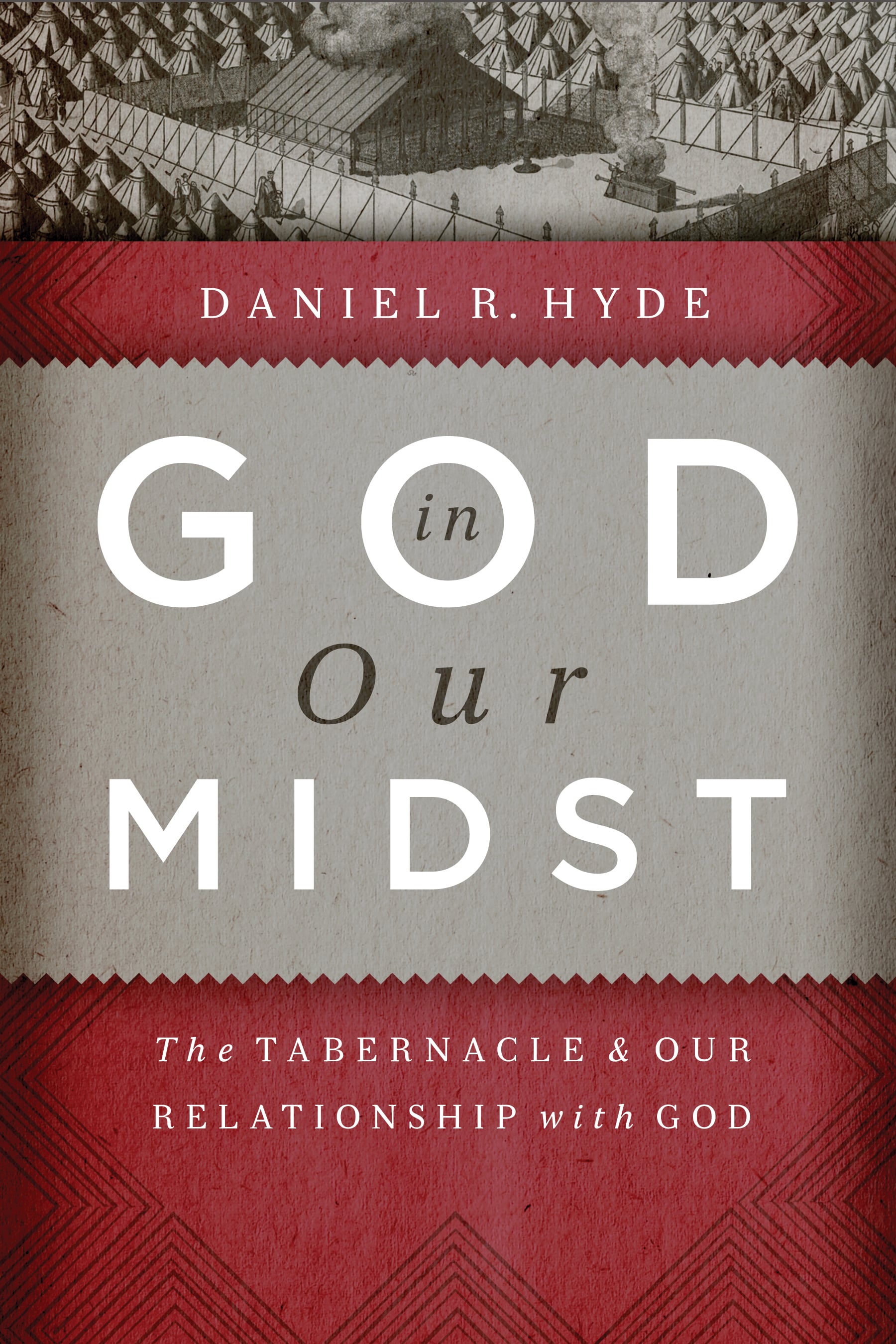
Book Review - God in Our Midst by Daniel Hyde

God in Our Midst: The Tabernacle and Our Relationship with God

I admit to being a sceptic when it comes to books and sermon series about the tabernacle, priests garments, and so forth. It seems to me that some writers and preachers see too much in the tabernacle. Surely one or two sermons, or a dozen or so pages, ought to cover it? Surely the Gospels and Hebrews give all the inspired and authoritative explanation of the tabernacle that Christians need? In fact, in Hebrews when speaking of the tabernacle, the unnamed author says 'Of these things we cannot now speak in detail' (Hebrews 9:5).

This book by Pastor Daniel Hyde is 220 pages of text and I was thinking, before reading it, that he probably sees too much. I really liked Alec Motyer's 15 pages in The Message of Exodus. However, the tabernacle instructions form a large part of Exodus and are therefore important to understand. In reading a larger book about the tabernacle I would expect the following:

  • Why is the tabernacle needed at this point?
  • What has God been doing in history up until this point?
  • What was the purpose of the tabernacle?
  • What did it mean to the people at the time?
  • What does it mean to Christians today?
Thankfully, the author also thinks some of these questions are important (p. 2) and seeks to answer them in the Introduction.

Daniel Hyde says 'The common purpose of Eden, the tabernacle, and the temple was that the creature could have fellowship with the Creator' (p. 25). He goes on to say:

They had experienced the reality that they were the "treasured possession" of the Lord (Ex. 19:5), but they had no Bibles. They had become a "kingdom of priests" (Ex. 19:6), but they had no catechisms. They had become a "holy nation" (ex. 19:6), but they had no Sunday school. How would the Lord teach a congregation that no doubt numbered two to three million souls (cf. Num. 1:45, 47) to leave behind the idolatry they had seen and experienced in Egypt, and to cling in faith to Him alone, having no other gods before Him (Ex. 20:3)? How would He instruct them to leave the false worship they had seen in Egypt and participate in the pure worship of God alone, having no carved images (Ex. 20:4)? The answer to these questions was the tabernacle. (pp. 45-46)
The author then makes his way through the Exodus narrative. The contents of 'God in Our Midst' were originally sermons and therefore the book reads very well. One stand-out feature is the amount of scripture Hyde quotes, particularly scripture that links OT with NT. Another stand-out feature is the very searching application (e.g. see pp. 54-55 and pp. 69-70). A final stand-out feature are the quotes from Church Fathers, creeds, and confessions. These writings and documents, although not perfect, were often forged in defence against heresy and are often profound.

There are only a few places when I thought the explanation of some feature of the tabernacle furniture was overwrought. For example. in chapter 4 - The Table With Bread - Hyde explains the crown molding around the table was to keep the bread and all holy utensils from falling off the table. He then goes on to say that '[t]his is a wonderful picture of the care of God for His people' (p. 76). Maybe, maybe not. I wonder if this is a case of 'the right doctrine from the wrong text'? Also, in chapter 6 - The Construction of the Tabernacle - Hyde makes the link from detailed instructions given to Moses to instructions for the for the worship of the Church (i.e. the regulative principle of worship - we only do what God has positively commanded). But why is Jesus not the point of this? We only come to worship Jesus in the way he has described - through Jesus. I will need to mull these points over but on first read they seemed a little off when compared to the rest of Hyde's applications.

This is a good devotional book on a large part of scripture that could be a little remote to most Christians today. Daniel Hyde has done a good job in showing the relevance of the tabernacle. There was at least one line of thought that was hinted at in the book, particularly in the conclusion (pp. 209 - 211), which is rattling around in my head - the tabernacle was a picture of Heaven. I would love to read more about this.

So has Daniel Hyde cured my scepticism? A little, but I still like Alec Motyer's 15 pages.

* To comply with Federal Trade Commission guidelines, I will receive a free copy of the book as compensation for this review. It was supplied by Reformation Trust.