Showing posts with label Commentary. Show all posts

Thursday, 5 July 2012

Why did you write this commentary (Deuteronomy)?

In the Author's Preface to his AOTC Deuteronomy commentary, J. G. McConville writes:

" It has been my privilege to be able to spend a lot of time with Deuteronomy over the years. Though one travels to other parts of the Old Testament, whether clad in the scholarly guise of the 'Deuteronomist' and ' Deuteronomistic' literature, or simply as the theological colossus that guards the entrance to Old Testament theology. So I am delighted to have been able to work on the present commentary, and to see it appear in the Apollos series."

Saturday, 30 June 2012

Why did you write this commentary (Numbers)?

Iain M. Duguid, pastor of Christ Presbyterian Church in Grove City PA, writes the following in his preface to Numbers: God's Presence in the Wilderness (Crossway, 2006):

"Before I began work on this volume, I had little exposure to the book of Numbers. I had never preached on a text from Numbers, nor, as far as I know, had I ever even heard a sermon on the book of Numbers. According to my anecdotal surveys of other pastors, I am far from being alone in that regard. When I told another Old Testament professor that I was currently preaching through the book, he expressed the opinion that it was scarcely meant to be preached. I'm sure he was simply saying out loud what many pastors have thought, and at times during the past eighteen months I have been tempted to sympathize with that opinion.

However, I hold firmly to another conviction that trumps any practical difficulties, the conviction that 'All Scripture is breathed out by God and profitable for teaching, for reproof, for correction, and for training in righteousness, that the man of God may be competent, equipped for every good work' (2 Timothy 3:16, 17). In addition, I understand the central message of the Scriptures from beginning to end to be the sufferings of Christ and the glories that would follow (1 Peter 1:10, 11; see Luke 24:44-47). I believe that a Christ-centered approach to preaching, which seeks to explore the way in which Old Testament passages prepare for and foreshadow the gospel, makes its truths accessible again to God's people. This approach feeds the hearts and souls of believers, as well as challenging unbelievers, with the result that even less familiar passages can speak powerfully to our congregations.

What I found as I proceeded was that the book of Numbers confronted us week by week with the challenge to live faithfully as pilgrims and aliens in a wilderness world and the encouragement to look to the One who has gone through this wilderness world ahead of us.

I would like to thank the people of Grace Presbyterian Church, Fallbrook for being such eager hearers of God's Word. Every Preacher needs people who have the gift of listening, and it has been a delight to preach the unsearchable riches of God's Word to you and to see your evident love for Christ and his gospel week after week."

Thursday, 21 June 2012

Why did you write this commentary (Leviticus)?

From the preface to Mark Rooker's Leviticus commentary (2000, B&H):

"At the end of the process of writing a commentary I am indebted to numerous individuals who have been of tremendous personal encouragement and assistance. I wish to express my appreciation first of all to Dr. George B. Davis, Sr., Associate Pastor of First Baptist Church of Dallas, Texas, who both encouraged me to work on Leviticus and was instrumental in recommending me to the New American Commentary series."

"I would like to offer a special thanks to my wife Carole for supporting me throughout the entire project. I would like to thank her for her consistent and patient encouragement to complete the commentary and the extra "sacrifices" she made for the undertaking to be completed. I gladly and appreciatively dedicate this work to her."

"As we begin the twenty-first century, it is apparent that the greatest fear our culture now faces may not be that of a nuclear catastrophe but rather corruption from within. We have witnessed a moral decay in all echelons of our society, even in high places. The religion of the Canaanites is making a decisive comeback! The Book of Leviticus calls us to a holy living under prescribed and unalterable ethical norms but also speaks of a way of atonement. In one sense no book of the Bible could be more relevant. My prayer is that this volume will be of assistance in the exposition and understanding of Leviticus for the church and that the Lamb of God who was sacrificed for our transgressions will be exalted. Thanks be to God for the time and strength He has given me to undertake this concentrated study on this precious but often neglected portion of Holy Scripture. Thanks be to the Lord Jesus Christ whom I have come to know in a more intimate way through the study of Leviticus (Luke 24:27)."

Tuesday, 19 June 2012

Why did you write this commentary (Exodus)?

Alec Motyer writes the following about his excellent (and worth purchasing) commentary on Exodus (2005, IVP):

"This book began its life in 1974 when the Keswick Convention invited me to prepare the morning Bible expositions – with an additional request for something from the Old Testament – and I elected to undertake Exodus. The work alerted me all over again to the richness and importance of the book, and the attempt to compress forty chapters into four hours got me interested in its structure.

My first request is that this book be read with an open Bible alongside, for the best benefits will be reaped by patient reading which takes time to look up cross-references. Where the structure of a section or passage is given in diagram form, please work through it, point by point, before going on to read what is written about it. Reference must be made here to the number of footnotes attached to this study of Exodus. Not everything important to the understanding of Exodus can be accommodated in an expository treatment, where the emphasis is on the emerging message, and so the footnotes are offered in the hope that they will give students and preachers access to this additional material. From time to time the footnotes threatened to ‘swamp’ the page! In these cases they have been moved to become additional notes attached to the chapter in question.

Cassuto says about his extensive commentary that, ‘we shall not cite the various interpretations (but) content ourselves with expounding the simple meaning of the text in the manner we deem correct’. This is the case here too, indeed it has to be so, for neither ability nor space would permit a comprehensive review and critique of what all the commentaries say. I have chosen, for example, not to give any sort of extensive introduction to the documentary analysis of the Pentateuch and Exodus into the famous J, E, D and P strands. It would, however, be an absurd ‘head-in-the-sand’ attitude to ignore totally an understanding of Exodus that has been so hugely influential. For myself, I have to confess that the documentary theory has never commanded my adherence or seemed to me the most helpful or natural way of approach. I plead for the tolerance of those who think otherwise. I have occasionally offered extra comments in the notes where it seems that this method particularly lacks coherence, evidence or persuasiveness.

Now that this particular bout of study on Exodus is finished, I shall miss it greatly: the sheer joy of engaging with its message; its frequently stately, sometimes earthy and businesslike, and always beautiful Hebrew; and its uplifting revelation of the Lord God in his power and patience, tenderness and redemption, and in his inflexible insistence on honouring his word and keeping his promises. In their history as recorded here, our early brothers, sisters and parents in the Israel of God found him in turn to be their covenant-keeping Redeemer in slavery, the Angel of the Lord, their divine companion in pilgrimage, and the Holy One indwelling their camp and sharing their lot. He is still unchangeably the same."

Saturday, 16 June 2012

Why did you write this commentary (Genesis)?

I now start a series of short posts focusing on the author's preface from commentaries I have found useful. Often, commentaries reveal very little about the author (as it should be) and the only place you get much of an insight in to their joys/pains in writing is in the preface. So without further ado ...

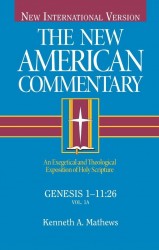
Kenneth A. Mathews writes the following about his commentary on Genesis 1–11:26 (published in 1996 by Broadman & Holman):

My generation has witnessed both the quintessential achievement of human knowledge and the collapse of the tyrannical Soviet empire which had subjugated millions in Western Asia and Eastern Europe for seventy years. My goal has been to present a commentary on Moses' First Book which offers insights but also incites the church to proclaim the Bible's first words to such a world ... In the study of Genesis I have learned anew both how inconsequential humanity is in God's expansive universe and yet the immense value that he has placed on each individual human life ... In a world increasingly made up of affluent technocrats and desperate autocrats, Genesis is God's first word concerning his gracious and faithful purpose to bless all men and women ... Genesis also has a first word that tells us we are sinners and have spoiled the good world, pointing us toward another Word, the full and last Word, who alone achieves for those who trust him the blessing that humanity was created to enjoy. May the words of this volume honor the first words and be acceptable to the last Word.
Kenneth A. Mathews also has written Genesis 11:27-50:26 which was published in 2005.