Thursday, 26 July 2012

Book Review - Connected: Living in Light of the Trinity by Sam Allberry

This is the second book on the Trinity that I have read in 2012 (the other being The Good God by Mike Reeves). It is vital to know God, but more specifically I am starting to realise (yes, after being a Christian for about 22 years) that knowing God as Trinity throws light on many other things. So why didn't I realise this at the age of 18? Well, I agree with Sam Allberry when he says

"The doctrine of the Trinity was carefully filed in the drawer of 'Things That All Good Christians Believe' and then never really seen again. I had no immediate need to look further into the Trinity, and a number of suspicious were holding me back:
  • It doesn't make sense
  • It's not meant to make sense
  • It's too technical
  • It's embarrassing
  • It's irrelevant"
(pp. 13-14)

Helpfully and appropriately Allberry says "Such thinking comes to an abrupt and happy halt the moment we begin to look more closely at what the Bible shows us about the Trinity" (p. 15). He goes on to say that:

"Understanding the Trinity helps us make sense of so much of what we hold dear: friendship, marriage, church, love, service, identity. Things that are precious to us, but which we are not always able to properly account for, find new significance when examined in the light of the Trinity. Things we cherish about God - his love and integrity, the coherence of his Word, the nearness of his presence, and, above all, his matchless love poured out for us through the death of Christ - all these can only make real sense when we discover that God is, in fact, Trinity" (pp. 15-16).

Allberry then, as he claimed, turns to the Bible, not so much to prove the doctrine of the Trinity in forms of dogmatics, but unfold the doctrine by looking at key passages. And like a wise pastor he starts to explore the Trinity by turning to the words of Jesus. In Mark 12:28 a teacher of the law asks Jesus "Of all the commandments, which is the most important?" And in Mark 12:29 Jesus answers "Hear, O Israel, the Lord our God, the Lord is one." We need to understand and know who God is before we can do what he commands. Allberry then spends chapters 1 and 2 exploring the significance of Jesus' reply to the teacher of the law. He says "It means more than being digitally singular. It speaks of there being a unity to God, that he is undivided ... [a]nd that means we can't have one person of the Trinity without the others" (p. 34).

Allberry also has a subtle and simple approach to teaching important truths. For example, when discussing how God's oneness directs our thinking about the death of Jesus, he refers to Jesus' baptism (Mark 1:9-11) and says:

"This is a wonderful scene of the Trinity in action. Jesus is going forward for baptism, the Spirit is descending and the Father is speaking. (If nothing else, this puts the boot into the idea that the Father, Son and Spirit are all just different roles or modes that God switches between)" (p. 39).

Chapters 3 and 4 then discuss God as Trinity. Again, Allberry takes the reader to the words of Jesus in Matthew 28:19 "Therefore go and make disciples of all nations, baptising them in the name of the Father and of the Son and of the Holy Spirit." Following Jesus means coming in to the reality of the Trinity. He quickly surveys the plurality of God in the Old Testament and then the Trinity in the New Testament. This is all good stuff and presented simply enough for even the most reluctant reader. Allberry says "The way in which God is one is different from the way in which he is three ... He is one in name and nature and he is three in person" (p. 60). Allberry also relies on John 5:19-23 to show Jesus' relationship with his Father. Importantly, he says that Father, Son and Spirit are not temporary roles, but eternal identities.

Part 2 of the book focuses more specifically on what the Trinity means for us. This is were I think the author is at his best. In Chapter 5, subtitled 'The Trinity and Humanity', Allberry says "... self-discovery starts here: God is Father, Son and Holy Spirit. All that we were made to be comes from knowing that. Our need for relationships, the importance of serving others, what it means to be sexual beings - all come into true light when seen in relation to our trinitarian Good" (p. 96).

The other chapters address:

  • 6 - The Trinity and Gender. Arguing from the equality, difference and headship in the Trinity to the equality, difference and headship in marriage.
  • 7 - The Trinity and Church. "Behind the unity-in-diversity of the Church is its heavenly analogue, the unity-in-diversity of the Trinity, and the operational diversity of the church is a reflection of the Trinity" (p. 122). Allberry zooms in on 1 Corinthians 12 which highlights the unity-in-diversity of our gifting. Positively he says "... the church is to be marked by the unity of God the Trinity. Our life together is to reflect that same love, mutual delight and other-person-centredness that characterises the relationships of the Father, Son and Spirit. And as the world looks on, it will see ... Christians showing unworldly care and concern for one another. Hearts, wallets and homes cheerfully opened to help those in need. Those from backgrounds you wouldn't normally see together enjoying their unity in Christ. Believers very different from one another but lit by a love of meeting together, of praising their Saviour and taking his word to heart" (p. 134). Very challenging my Anglican friend.
  • 8 - The Trinity and Prayer. Allberry explains that prayer is trinitarian because it is offered by the Spirit, through the Son, to the Father. This is an excellent chapter and I could provide plenty of quotes that really broadened my understanding of the basics of prayer. Prayer is something I often struggle with but this chapter was a real encouragement to keep praying.
  • 9 - A fine exposition of Ephesians 1:3-14 which is a mammoth trinitarian sentence of praise from the lips of the apostle Paul.

Sam Allberry has written a very practical book on the significance of the Trinity. It is easy to read and has helpful illustrations. In fact, it reads so easy that it was not until my second pass through that the profundity of some of his points really jumped out at me. There was a little repetition in the book but that is no bad thing given the topic. Also, section 1 - which addresses the doctrine of the Trinity - could have been a little more meaty and contain an extra chapter presenting the positive scriptural case for the Trinity. In summary, I recommend this book to all Christians and it will likely help us think again about the God who made us, revealed himself to us and adopts us as his children.

* This book was supplied for review by IVP Books.

Thursday, 5 July 2012

Why did you write this commentary (Deuteronomy)?

In the Author's Preface to his AOTC Deuteronomy commentary, J. G. McConville writes:

" It has been my privilege to be able to spend a lot of time with Deuteronomy over the years. Though one travels to other parts of the Old Testament, whether clad in the scholarly guise of the 'Deuteronomist' and ' Deuteronomistic' literature, or simply as the theological colossus that guards the entrance to Old Testament theology. So I am delighted to have been able to work on the present commentary, and to see it appear in the Apollos series."

Saturday, 30 June 2012

Why did you write this commentary (Numbers)?

Iain M. Duguid, pastor of Christ Presbyterian Church in Grove City PA, writes the following in his preface to Numbers: God's Presence in the Wilderness (Crossway, 2006):

"Before I began work on this volume, I had little exposure to the book of Numbers. I had never preached on a text from Numbers, nor, as far as I know, had I ever even heard a sermon on the book of Numbers. According to my anecdotal surveys of other pastors, I am far from being alone in that regard. When I told another Old Testament professor that I was currently preaching through the book, he expressed the opinion that it was scarcely meant to be preached. I'm sure he was simply saying out loud what many pastors have thought, and at times during the past eighteen months I have been tempted to sympathize with that opinion.

However, I hold firmly to another conviction that trumps any practical difficulties, the conviction that 'All Scripture is breathed out by God and profitable for teaching, for reproof, for correction, and for training in righteousness, that the man of God may be competent, equipped for every good work' (2 Timothy 3:16, 17). In addition, I understand the central message of the Scriptures from beginning to end to be the sufferings of Christ and the glories that would follow (1 Peter 1:10, 11; see Luke 24:44-47). I believe that a Christ-centered approach to preaching, which seeks to explore the way in which Old Testament passages prepare for and foreshadow the gospel, makes its truths accessible again to God's people. This approach feeds the hearts and souls of believers, as well as challenging unbelievers, with the result that even less familiar passages can speak powerfully to our congregations.

What I found as I proceeded was that the book of Numbers confronted us week by week with the challenge to live faithfully as pilgrims and aliens in a wilderness world and the encouragement to look to the One who has gone through this wilderness world ahead of us.

I would like to thank the people of Grace Presbyterian Church, Fallbrook for being such eager hearers of God's Word. Every Preacher needs people who have the gift of listening, and it has been a delight to preach the unsearchable riches of God's Word to you and to see your evident love for Christ and his gospel week after week."

Thursday, 21 June 2012

Why did you write this commentary (Leviticus)?

From the preface to Mark Rooker's Leviticus commentary (2000, B&H):

"At the end of the process of writing a commentary I am indebted to numerous individuals who have been of tremendous personal encouragement and assistance. I wish to express my appreciation first of all to Dr. George B. Davis, Sr., Associate Pastor of First Baptist Church of Dallas, Texas, who both encouraged me to work on Leviticus and was instrumental in recommending me to the New American Commentary series."

"I would like to offer a special thanks to my wife Carole for supporting me throughout the entire project. I would like to thank her for her consistent and patient encouragement to complete the commentary and the extra "sacrifices" she made for the undertaking to be completed. I gladly and appreciatively dedicate this work to her."

"As we begin the twenty-first century, it is apparent that the greatest fear our culture now faces may not be that of a nuclear catastrophe but rather corruption from within. We have witnessed a moral decay in all echelons of our society, even in high places. The religion of the Canaanites is making a decisive comeback! The Book of Leviticus calls us to a holy living under prescribed and unalterable ethical norms but also speaks of a way of atonement. In one sense no book of the Bible could be more relevant. My prayer is that this volume will be of assistance in the exposition and understanding of Leviticus for the church and that the Lamb of God who was sacrificed for our transgressions will be exalted. Thanks be to God for the time and strength He has given me to undertake this concentrated study on this precious but often neglected portion of Holy Scripture. Thanks be to the Lord Jesus Christ whom I have come to know in a more intimate way through the study of Leviticus (Luke 24:27)."

Tuesday, 19 June 2012

Why did you write this commentary (Exodus)?

Alec Motyer writes the following about his excellent (and worth purchasing) commentary on Exodus (2005, IVP):

"This book began its life in 1974 when the Keswick Convention invited me to prepare the morning Bible expositions – with an additional request for something from the Old Testament – and I elected to undertake Exodus. The work alerted me all over again to the richness and importance of the book, and the attempt to compress forty chapters into four hours got me interested in its structure.

My first request is that this book be read with an open Bible alongside, for the best benefits will be reaped by patient reading which takes time to look up cross-references. Where the structure of a section or passage is given in diagram form, please work through it, point by point, before going on to read what is written about it. Reference must be made here to the number of footnotes attached to this study of Exodus. Not everything important to the understanding of Exodus can be accommodated in an expository treatment, where the emphasis is on the emerging message, and so the footnotes are offered in the hope that they will give students and preachers access to this additional material. From time to time the footnotes threatened to ‘swamp’ the page! In these cases they have been moved to become additional notes attached to the chapter in question.

Cassuto says about his extensive commentary that, ‘we shall not cite the various interpretations (but) content ourselves with expounding the simple meaning of the text in the manner we deem correct’. This is the case here too, indeed it has to be so, for neither ability nor space would permit a comprehensive review and critique of what all the commentaries say. I have chosen, for example, not to give any sort of extensive introduction to the documentary analysis of the Pentateuch and Exodus into the famous J, E, D and P strands. It would, however, be an absurd ‘head-in-the-sand’ attitude to ignore totally an understanding of Exodus that has been so hugely influential. For myself, I have to confess that the documentary theory has never commanded my adherence or seemed to me the most helpful or natural way of approach. I plead for the tolerance of those who think otherwise. I have occasionally offered extra comments in the notes where it seems that this method particularly lacks coherence, evidence or persuasiveness.

Now that this particular bout of study on Exodus is finished, I shall miss it greatly: the sheer joy of engaging with its message; its frequently stately, sometimes earthy and businesslike, and always beautiful Hebrew; and its uplifting revelation of the Lord God in his power and patience, tenderness and redemption, and in his inflexible insistence on honouring his word and keeping his promises. In their history as recorded here, our early brothers, sisters and parents in the Israel of God found him in turn to be their covenant-keeping Redeemer in slavery, the Angel of the Lord, their divine companion in pilgrimage, and the Holy One indwelling their camp and sharing their lot. He is still unchangeably the same."

Saturday, 16 June 2012

Why did you write this commentary (Genesis)?

I now start a series of short posts focusing on the author's preface from commentaries I have found useful. Often, commentaries reveal very little about the author (as it should be) and the only place you get much of an insight in to their joys/pains in writing is in the preface. So without further ado ...

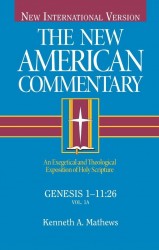
Kenneth A. Mathews writes the following about his commentary on Genesis 1–11:26 (published in 1996 by Broadman & Holman):

My generation has witnessed both the quintessential achievement of human knowledge and the collapse of the tyrannical Soviet empire which had subjugated millions in Western Asia and Eastern Europe for seventy years. My goal has been to present a commentary on Moses' First Book which offers insights but also incites the church to proclaim the Bible's first words to such a world ... In the study of Genesis I have learned anew both how inconsequential humanity is in God's expansive universe and yet the immense value that he has placed on each individual human life ... In a world increasingly made up of affluent technocrats and desperate autocrats, Genesis is God's first word concerning his gracious and faithful purpose to bless all men and women ... Genesis also has a first word that tells us we are sinners and have spoiled the good world, pointing us toward another Word, the full and last Word, who alone achieves for those who trust him the blessing that humanity was created to enjoy. May the words of this volume honor the first words and be acceptable to the last Word.
Kenneth A. Mathews also has written Genesis 11:27-50:26 which was published in 2005.

Monday, 11 June 2012

New Atheism - A Passing Fad?

Mark Baddeley has written a great little article on New Atheism (think Richard Dawkins, Sam Harris, Christopher Hitchens et al.). Here are a few quotes to whet your appetite:

A few years ago at an event hosted by Oxford University’s resident atheist, secularist, and humanist societies, one speaker lectured on the question “Can the natural sciences answer all questions?” To my surprise, it turns out his answer was “Yes, the natural sciences can answer all real questions”. He apparently argued strongly that questions like “What is the meaning of life?” or “What is good and evil?” or even “What does it mean to be a human?” are not real questions. Real questions involve the chemical composition and molecular make-up of bits of the human body, questions about the rate of fusion in stars, and the like. Only questions that can be answered by scientifically analysing nature are real. All other questions are merely errors in thinking.

There’s three problems here, and it seems to me that they are endemic whenever New Atheism raises its head.

First, this isn’t primarily an assault upon God. It’s primarily an assault on everything other than the natural sciences. Yes, obviously the speaker above was attacking the validity of theology as a discipline and whether there is a God to be known. But he’s also throwing philosophy under the bus, along with history, literature, psychology, education, sociology, and anthropology. It is a rejection of the validity of any discipline other than natural science, because apparently only natural scientists ask real questions. Everyone else is wasting their time.

This kind of radical empiricism is only ever going to appeal to a very small group of people—natural scientists, and people who wish they were natural scientists. The vast majority of the human race have to deal with questions that cannot be answered by the natural sciences, and value those disciplines that help them to come to grips with them. This extraordinary shrinking of what human beings are allowed to ask questions about just doesn’t ring true for most people. Life is more than the lab.

[T]he kind of people who are attracted to the arguments of New Atheism will invariably be people who have an aptitude for science and some kind of respect for scientists and the capacities of the scientific method. People who don’t care, or who are orientated to other aspects of life, like art, are rarely going to be swayed much by New Atheism (although they may be attracted to forms of atheism grounded in other approaches). Thinking highly about science is hardly a bad thing—science is a good gift from God—but it is something to keep in mind. One of the things that might be useful to check and address when you think someone might be susceptible to New Atheist arguments is the level of the person’s respect for science and scientists. Do they think science can answer almost any question, for example? Do they see it as having any limits, and if so, what?

I can also recommend my friend David Glass's book Atheism's New Clothes.